Breakfast for two

Sociable eating in pets—more formally described as social facilitation of feeding—is a well-documented behaviour in companion animals. It refers specifically to individuals who prefer to eat in the presence of a trusted companion, often their human, and should not be confused with those who will only eat if a companion is present and refuse food unless this need is met. Neither would social feeding be recommended, where food guarding behaviours, which are driven by anxiety and competition rather than comfort and social bonding.
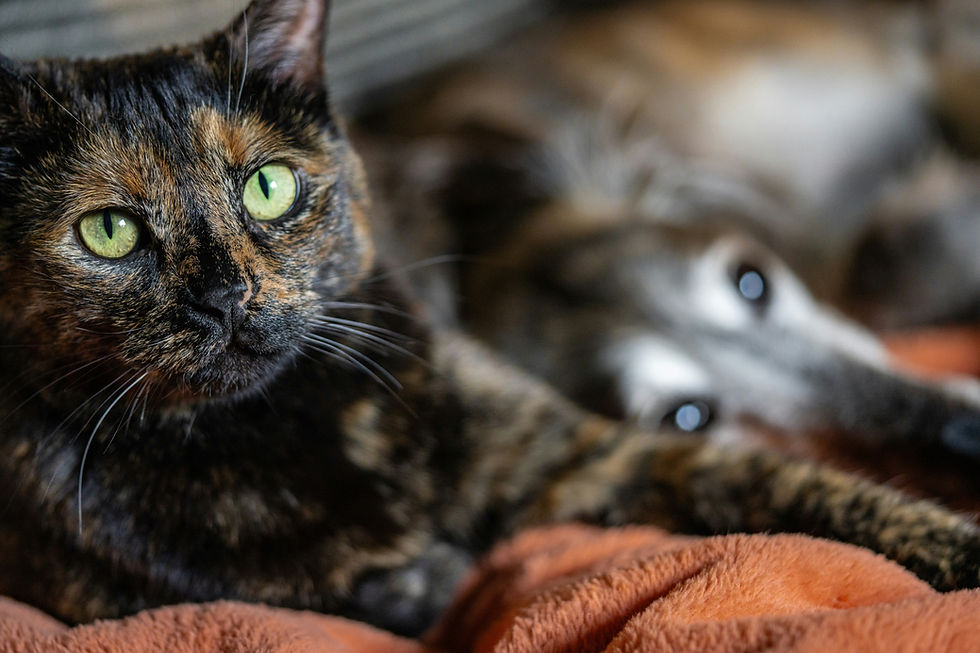
Take, for example, my cat Dougal. Dougal does not simply ‘eat breakfast’; Dougal requests very loudly that he needs company to eat in the morning. Preferably on the sofa, beside me, as though we are sharing a civilised breakfast before the day gets going. If his food is presented in the kitchen, it is met with polite but loud rejection. Relocated to the sofa, immediate acceptance. From a scientific perspective, Dougal is demonstrating classic socially facilitated feeding—though he would likely argue it is just good morning social behaviour, having kept watch on the garden overnight. And as 18.5 years old diabetic cat, I am happy to facilitate. Interestingly lunch and dinner are taken on the floor and grazed upon.
This behaviour has roots in evolutionary biology. Eating in the presence of a trusted individual can signal safety, reducing vigilance and stress. In domestic environments, humans often become the primary social partners, so their presence provides reassurance. This effect is particularly evident in older animals. Geriatric pets commonly experience reduced appetite due to sensory decline or underlying disease, and the simple act of sitting with them, or hand feeding in some cases, or in Dougal’s case, hosting them on the sofa, can significantly improve food intake.
In veterinary practice, this principle is often applied deliberately. Veterinary nurses frequently support inappetent or recovering patients by offering food in a calm, low-stress environment, sometimes sitting with them or hand-feeding. These interactions are not merely kind gestures; they are clinically valuable. Encouraging voluntary feeding supports convalescence by promoting energy intake, immune function, and tissue repair.
So, while Dougal’s sofa breakfasts may appear indulgent, they reflect a broader, evidence-based concept: for some animals, companionship is not just comforting—it is an essential part of eating well.
My wonderful colleague Shelley who is on the team now, also fulfilled this role last year when I was away and I am happy to say that she is now able to offer my clients cat feeding services in the Worthing area. I trust her implicitly with Dougal and highly recommend her, get in touch with me if you need details.